How Nantes answered post-industrial collapse not with glass towers and tax breaks, but with a Giant Elephant and a green line on the pavement — and quietly became Europe's most creative reinvention story.
01 The Wound That Started Everything
Nantes in the 1980s was a city staring at its own wreckage. The Loire shipyards — which had launched vessels into the river since the nineteenth century and employed tens of thousands at their peak — closed definitively in 1987, leaving the Île de Nantes as a vast, rusting, ambiguous gift. What do you do with a kilometre of dry docks, cranes, and industrial sheds when the industry that built them is gone? Most cities would have answered: demolish it, build apartments, move on.
Nantes answered differently. It took a generation to find the right language for what it wanted to do, and the answer, when it came, was decisively strange. The city would not erase its industrial past or prettify it into a heritage theme park. It would transform it into something alive — an ongoing artwork, a question rather than an answer, a machine for generating surprise. The shipyard cranes on the Île de Nantes were kept standing, not as relics but as punctuation marks. The sheds that once housed hulls now house art schools, architecture studios, and the most extraordinarily impractical creative project in contemporary France.
Beauty, strangeness and civic imagination are not extras you add once the economics are sorted — they are conditions that make better economics possible.
02 Le Voyage à Nantes: The Route That Rewired the City
The strategic turn has a name — Le Voyage à Nantes — and it has a shape: a green line painted on the pavement that threads from the château des ducs de Bretagne, through the old city centre, across the Île de Nantes, and out along the Loire, linking more than a hundred artworks, installations, architecture, and cultural landmarks into a single walkable route. In summer, the route activates fully, with new commissions added each year, so that regular Nantais as well as first-time visitors find things they haven't seen before. The line is not a tourist trail so much as a citywide curatorial act — the same sensibility that programmes a gallery applied, audaciously, to streets, bridges, quays, and empty lots.
Jean Blaise, who had already built a reputation as the force behind extraordinary urban arts events in Nantes, was the intellectual architect of Le Voyage. The project's founding logic was simple and radical: if you stop treating culture as something that happens inside buildings and start treating the city itself as the exhibition space, you change not just what people see but how they move, what they notice, and, eventually, how they feel about where they live. The green line is easy to dismiss as a PR gimmick — until you follow it and realise it takes you past a submerged house in a courtyard, along quays you wouldn't otherwise have found, into conversations about a city thinking hard about itself.
The results, measured in any terms you care to choose, are real. Nantes was named European Green Capital in 2013. It consistently tops French quality-of-life rankings. It has attracted creative industries, students, and relocating Parisians at a rate that has quietly made it one of France's fastest-growing cities. None of that has a single cause, but the decision to treat cultural ambition as urban policy — rather than a ribbon-cutting luxury — runs through all of it.
03 The Elephant in the Room (Literally)
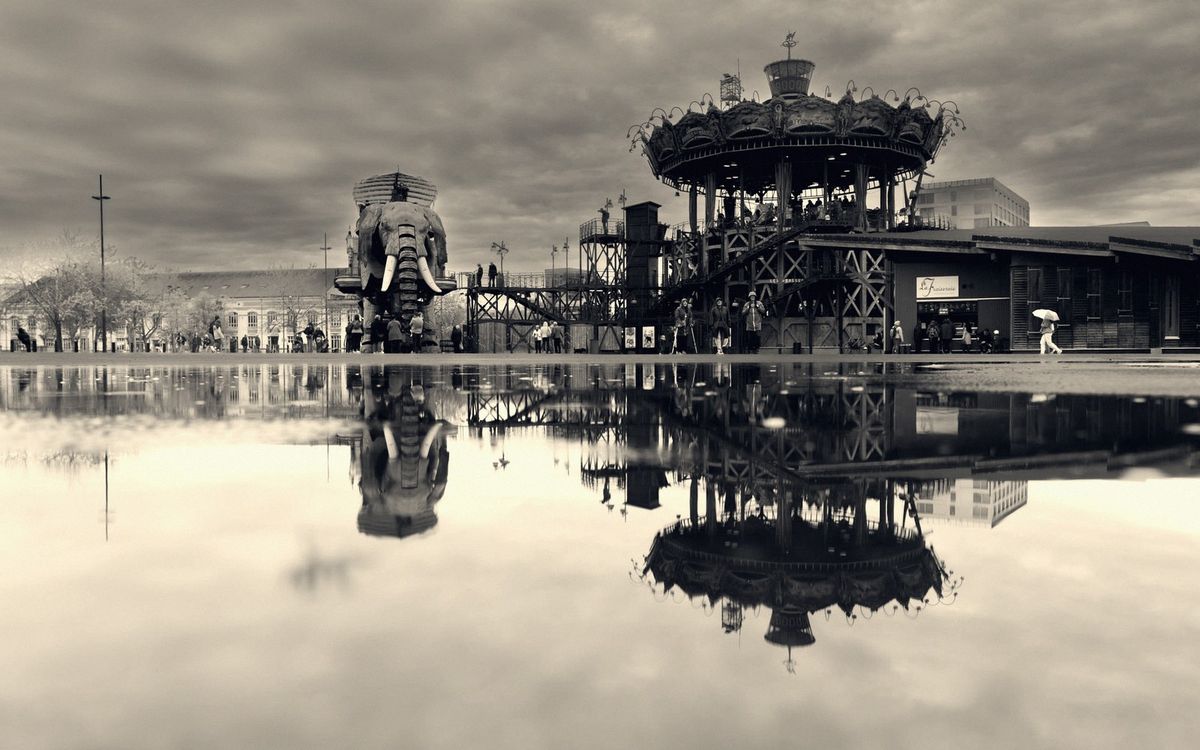
The single most visible emblem of the reinvention is also its most joyfully excessive. The Machines de l'île occupy the former Dubigeon shipyard sheds on the island's western tip, and what they have built inside — and outside — those sheds is a mechanised universe drawn from the imaginations of Jules Verne and Leonardo da Vinci, rendered in steel and leather and vast quantities of craft. The Great Elephant is twelve metres tall and weighs around forty-eight tonnes; it walks along the quayside carrying passengers on its back. Inside the gallery, a Marine Worlds Carousel rises through three storeys of extraordinary creatures — deep-sea fish, a heron, a giant crab — that visitors can ride as they slowly revolve. A third project, the Heron Tree, was planned to complete the triptych but has not been built.
It would be easy to love the Machines purely as spectacle, and spectacle is certainly what they deliver. But their deeper significance is that they embody the philosophy of the whole project: that reinvention should be rooted in the specific — in this case, Nantes's twin inheritances of Jules Verne's visionary fiction and the shipyard workers' extraordinary manual ingenuity — rather than imported from a generic playbook. The craftspeople who build the Machines are working in the direct lineage of the chaudronniers, the boilermakers, who once built ships in the same sheds. The elephant is not a distraction from industrial history. It is industrial history, transformed.
04 An Island That Kept Becoming
The Île de Nantes remains the most concentrated expression of what the city has been attempting. The former Alstom and Dubigeon yards now contain the Nantes School of Fine Arts and the School of Architecture, meaning that the studios where ships were designed now train the people who will design whatever comes next. The island's eastern end, around the Feydeau district, is thicker with residential renovation; the western tip, around the Machines, is more deliberately strange. In between, the island accommodates both.
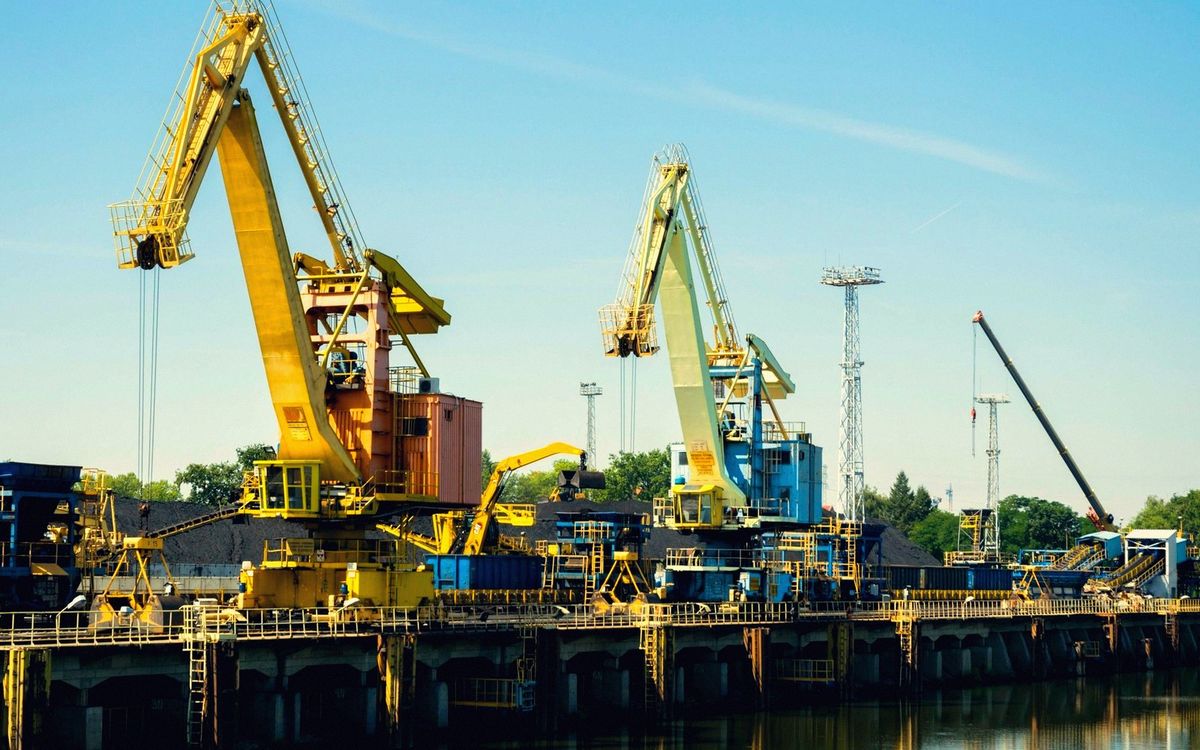
The cranes that weren't demolished are extraordinary objects in the urban landscape — bright yellow against the Loire sky — and walking beneath them without a map, following the river rather than any plan, is one of the better unstructured hours you can spend in Nantes. The island has rough edges that are features, not bugs. The reinvention was never presented as complete, and that is probably why it doesn't feel finished and managed like a development brochure. The building sites are real. The art school students cycling past are real. The sense that something is still being made — that you've arrived mid-process rather than post-renovation — is the most persuasive thing about the place.
05 The Model, and Its Limits
Other cities have studied Nantes carefully, and the lessons are regularly cited at the kind of conferences where urban planners gather: invest in culture before infrastructure, involve artists early in redevelopment, resist the urge to resolve ambiguity too quickly. These are not bad lessons. Bilbao learned its own version; Liverpool learned its. What Nantes has that is harder to export is the specific combination of institutional continuity — the same cultural vision sustained across decades of local government — with genuine creative risk. The Machines de l'île could have been vetoed as too expensive, too eccentric, too hard to explain to a budget committee. It wasn't.
There are real pressures now: gentrification on the island is accelerating, rents in the city centre rise each year, and the bohemian affordability that attracted artists and students in the first place is no longer quite what it was. The green line can't solve a housing market. The creative-city model is not frictionless, and Nantes is honest enough, as a place, to show that.
But the core wager — that beauty, strangeness, and civic imagination are not extras you add when the economics are sorted but conditions that make better economics possible — remains more vindicated here than almost anywhere in Europe. That, more than any single landmark, is what Nantes has built.
Time How it happened
- 19th centuryLoire shipyards at peak industrial activity
- 1987shipyard closure; beginning of post-industrial period
- 2000sLe Voyage à Nantes concept developed under Jean Blaise
- 2007Machines de l'île opens; 2012 Le Voyage à Nantes formally established
- 2013Nantes named European Green Capital
Who The people
Jean Blaise
Cultural producer
The intellectual architect of Le Voyage à Nantes — the man who argued the whole city could be the exhibition space.
François Delarozière
Machine-builder
Scenographer behind the Great Elephant and the mechanical menagerie that became the city's emblem.