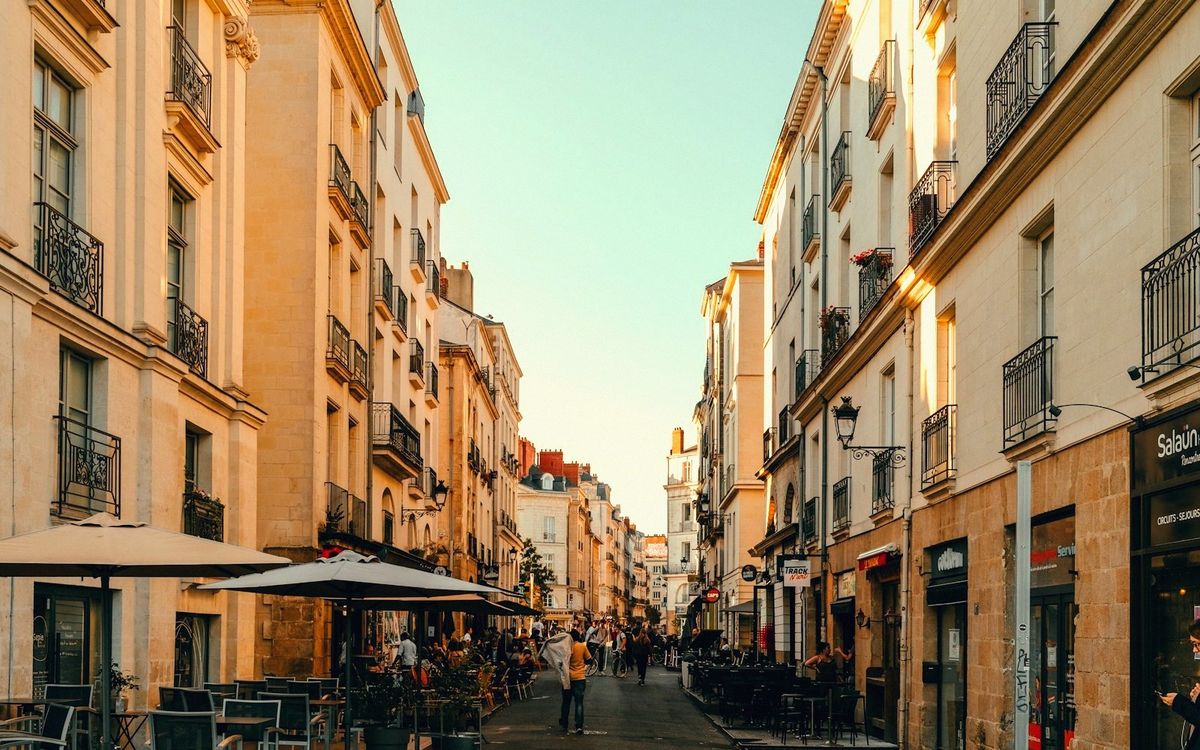
The medieval lanes and the ducal château where Nantes keeps its oldest stories.
01 The heart of the old city
Nantes was a Breton capital before it was a French one, and nowhere makes that plainer than the Bouffay quarter — a tight knot of medieval lanes between the Place du Bouffay and the rue de la Juiverie, where the half-timbered façades lean close enough to trade secrets across the street. It feels genuinely old because it is: this was the commercial and judicial centre of ducal Nantes, home to markets, gallows and guild halls long before Haussmann's instinct for the straight line reached the Loire.
The neighbourhood is lively rather than preserved-in-amber. The ground floors run to independent bars, crêperies and a few terraces that fill fast on warm evenings. The cobbles and the crooked rooflines do the atmospheric work; no one has themed it. Duck into the rue de la Bâclerie and you can still feel the medieval street plan beneath your feet.
The half-timbered façades lean close enough to trade secrets across the street.
Anchoring the whole quarter, the Château des Ducs de Bretagne is one of the genuinely great urban fortresses of France — a fifteenth-century moated castle that Anne of Brittany called home and that now houses the Musée d'Histoire de Nantes within its walls. The courtyard is free to enter, the museum inside tells the city's full story — the slave trade included, unflinchingly — and the rampart walk gives a rooftop view over the old town that reframes everything you've just wandered through.
Come in the evening if you can. The château is floodlit, the Bouffay lanes are at their most convivial, and the whole quarter earns its age gracefully.
Who The people
Anne of Brittany
Duchess · twice Queen of France
Born and raised in the château des ducs de Bretagne, the fortress that anchors the quarter.